Leave Your Message

China Top 10 Fridge Storage Drawers Manufacturers?

Choosing a reliable supplier for Fridge Storage Drawers takes more than comparing prices or polished product photos. Buyers need to consider drawer dimensions, usable capacity, material quality, smooth movement, and compatibility with specific refrigerator models. A drawer that looks sturdy online may feel flimsy when loaded with bottles or produce. Small details matter.

This guide to China’s top 10 Fridge Storage Drawers manufacturers is a practical starting point, not a substitute for supplier checks. It can help importers, appliance brands, and distributors compare product ranges, manufacturing capabilities, customization options, and communication. Where available, review factory information, sample quality, inspection records, and clearly stated product specifications. Ask how materials are selected and how drawers are tested under ordinary use. A responsive sales team is useful, but production consistency matters more.

The “top 10” label should be read carefully. Rankings can change, and a manufacturer suited to one project may not fit another. One supplier might offer flexible designs, while another may be better equipped for larger orders. Confirm current capabilities directly, request samples, and check that dimensions match your appliance requirements before making decisions. Even careful research has limits. Product information may be incomplete, and samples cannot reveal every issue in long-term use. A thoughtful comparison helps narrow the field while keeping expectations realistic.
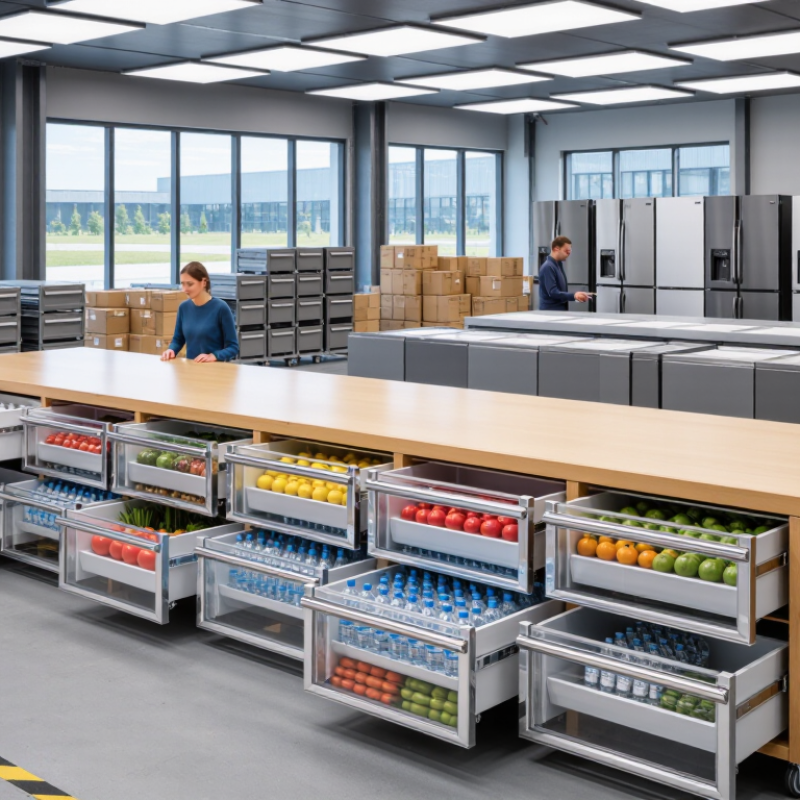
China Top 10 Fridge Storage Drawers Manufacturers?

What Refrigerator Storage Drawers Are and How They Are Used

Refrigerator storage drawers are enclosed compartments that organize food and help manage humidity. Crisper drawers usually have adjustable vents: a closed vent retains moisture, which suits leafy greens, while an open vent lets moisture escape and often works better for many fruits. Separate fruits from delicate vegetables when possible; some fruits release ethylene, which can speed up ripening nearby. Drawer labels can be confusing, and not every refrigerator uses the same settings.

Use drawers for produce you reach for often, and keep them clean and dry. Store raw meat in a sealed container on a lower shelf, not above ready-to-eat food. The U.S. Food and Drug Administration recommends keeping refrigerators at 40°F (4°C) or below; drawers do not replace temperature control. The USDA’s FoodKeeper resource offers food-specific storage guidance, while USDA estimates that 30–40% of the U.S. food supply is wasted. Drawers may help prevent bruising and forgotten produce, but they cannot guarantee freshness. Not a cure-all. Check what is inside every few days, remove spoiled items, and avoid packing drawers so tightly that air cannot circulate.


Refrigerator Crisper Drawers: Typical Storage Life for Produce

Crisper drawers help organize produce and manage humidity. The values below show approximate refrigerated storage-life midpoints; actual life varies with freshness, refrigerator temperature, and handling.

Typical ranges: apples 3–4 weeks, carrots 2–3 weeks, broccoli 3–5 days, and leafy greens about 3–7 days. Keep the refrigerator at 4°C (40°F) or below. Use higher humidity for leafy vegetables and lower humidity for many fruits. Guidance: USDA FoodKeeper and FoodSafety.gov.

How China’s Refrigerator Drawer Manufacturing Sector Is Organized

China’s refrigerator drawer manufacturing sector is organized around linked capabilities, rather than one uniform factory model. Some suppliers mold clear or opaque plastic bins, while others focus on rails, trim, or complete drawer assemblies. Factories serving appliance producers often work from customer drawings and dimensional tolerances. Small differences matter.

An injection-molding line may combine resin drying, controlled heating, mold clamping, cooling, and visual inspection. Operators check wall thickness, edge finish, and fit against cabinet samples. A drawer that binds when loaded can require rework. Specialist makers may supply rollers, dampers, or reinforced corners, which assembly facilities then fit and test. Not glamorous work.

Production often connects coastal industrial networks, where mold shops, resin distributors, packaging firms, and appliance plants can coordinate shipments. Proximity can shorten feedback cycles, though it does not guarantee consistent quality. Buyers commonly review samples, batch records, load performance, temperature resistance, and packaging protection before expanding orders. Transparent drawers reveal scratches and stress marks immediately. That detail is easy to underestimate. Inspection standards can still vary between suppliers.

Criteria for Identifying Leading Chinese Manufacturers

A careful search for leading Chinese fridge storage drawer manufacturers should start with product evidence, not catalog photos. Check whether the supplier understands refrigerator-grade plastics, low-temperature impact, and repeated opening under household loads. Ask for material specifications and sample parts. Examine the drawer walls, corner radii, handle joints, and rail fit. A loaded drawer should slide without scraping or tilting. Small gaps matter. Request test details, including temperature conditioning, load duration, and cycle counts. These details help separate repeatable engineering from a one-off sample.

Production consistency matters as much as design. Review inspection records, defect-handling procedures, and traceability for incoming materials and finished parts. Ask how tooling changes are controlled and whether dimensional checks use documented tolerances. Visit the facility when practical, or request a live video walkthrough of molding, inspection, and packing areas. Confirm realistic capacity and lead times using actual production schedules. A neat showroom is not proof of stable output. Communication is also evidence: clear replies and specific corrective actions are more useful than broad promises. Some evaluations still rely too heavily on samples; that is worth challenging.

Tips: Compare samples from separate production runs, not just one handpicked unit. Measure drawer width, rail clearance, and handle strength with simple tools. Keep written records of specifications and approved changes. If answers remain vague, pause before committing.

China Top 10 Fridge Storage Drawers Manufacturers? - Criteria for Identifying Leading Chinese Manufacturers

Use these ten criteria to assess and compare manufacturers. This is an evaluation framework, not a verified ranking of named companies; confirm each supplier’s claims, documents, and product samples independently. Regulatory requirements depend on the product design and destination market.

No. Evaluation criterion What to assess Evidence to request or check Suggested weight
1 Product and process capability Experience producing refrigerator drawers and related components, such as bins, trays, rails, and covers; ability to manage the processes required by the design. Product catalogs, process descriptions, factory audit, and samples representative of current production. 15%
2 Material and design suitability Material selection, dimensions, load requirements, transparency, color, and resistance to the temperatures and conditions specified for the intended refrigerator application. Material specifications, approved drawings, test results, and confirmation that the sample matches the quoted material and design. 12%
3 Quality management and traceability Documented inspection procedures, control of nonconforming parts, batch identification, and corrective-action processes. Quality-system documentation, inspection records, traceability examples, and certificates verified with the issuing body where applicable. 12%
4 Product testing and validation Whether performance checks reflect the buyer’s intended use, including fit, dimensions, load, repeated operation, and relevant environmental conditions. Test plans and dated reports identifying the tested model, method, acceptance criteria, and results. 11%
5 Regulatory and market documentation Ability to provide documentation appropriate to the product, materials, and destination market. Requirements vary by jurisdiction and intended use. Applicable declarations, material documents, and test reports; check scope, validity, model coverage, and issuing organization. 10%
6 Production capacity and delivery planning Available production resources, tooling capacity, realistic lead times, and ability to plan for forecast changes without relying on unsupported capacity claims. Production schedule, capacity basis, lead-time history, and, where appropriate, an on-site or third-party factory audit. 10%
7 Tooling and customization capability Support for customer drawings, dimensional revisions, color matching, prototypes, and control of molds or other customer-funded tooling. Quotation with tooling scope and ownership terms, prototype process, revision control, and written approval procedures. 9%
8 Supply-chain and change control Controls over material sourcing and production changes, including advance notification and approval for changes that could affect fit or performance. Supplier-control procedure, material change records, and written change-notification and approval terms. 8%
9 Packaging and shipping protection Packaging design suited to the drawer’s shape and fragility, with appropriate protection against handling and transport damage. Packaging specification, sample pack-out, shipping test evidence where available, and documented damage-claim process. 7%
10 Communication and after-sales support Responsiveness, clarity of technical communication, order follow-up, and a defined process for handling defects or corrective actions. Response records during sampling, named points of contact, written warranty terms, and complaint-resolution procedure. 6%
Total suggested evaluation weight 100%

Profiles of Ten Chinese Refrigerator Storage Drawer Manufacturers

China’s refrigerator storage drawer suppliers vary in tooling, materials, and production scale. These ten profiles describe useful supplier types, not a verified ranking of named factories.

A tooling-focused manufacturer designs drawer molds and adjusts wall thickness to reduce warping.

A materials specialist selects clear or tinted refrigerator-grade plastics and checks sample parts for brittleness.

An OEM and ODM supplier works from customer drawings, then develops prototypes for fit checks.

A precision molder focuses on smooth edges, consistent dimensions, and drawer fronts that align with cabinet openings.

A testing-oriented factory evaluates repeated opening, loading, and low-temperature performance.

Details matter.

An integrated producer handles molding, trimming, inspection, and packing under one roof.

An export-focused supplier pays close attention to carton strength and moisture protection during long-distance shipping.

A small-batch workshop may suit trial orders, though its capacity can be limited.

A custom-color supplier matches approved samples, but shade differences between production runs remain possible.

A quality-led manufacturer records inspection results and traces defects to specific batches.

Ask for recent sample measurements, material documentation, and production photos before selecting a partner. Capabilities change, and a polished catalog alone is not proof of consistent output.

How to Compare Manufacturers for Quality, Cost, and Supply Needs

When comparing China-based refrigerator storage drawer manufacturers, look beyond catalog photos. Ask for resin type, wall thickness, load rating, temperature range, and fit dimensions. Request a sample and inspect its corners, sliding rails, and clearances. A drawer that looks sturdy can still bind when chilled. Small details matter.

Quality evidence should be repeatable. Ask for material specifications, inspection records, and test results for repeated opening, impact, and temperature cycling. Check how defects are recorded and how rejected batches are handled. A video is useful, but it is not the same as a written process. If possible, compare samples from different production dates. That check takes time.

Compare landed cost, not just unit price. Include tooling, packaging, sample fees, freight, and replacement terms in one quote sheet. Confirm minimum order quantities, monthly output, lead times, and how delays are communicated. Be specific. For example, request a production schedule for 2,000 drawers and a carton drop-test report. Some suppliers may answer quickly but leave details vague; that is a reason to ask again, not proof of poor quality. These checks can feel fussy, yet a low-priced drawer that arrives scratched or fits loosely can cost more to resolve.