7 Tips for Buying an Electric Chicken Rotisserie Oven
Choosing an Electric Chicken RotisserieOven is not simply a matter of buying the hottest machine. It is a decision about food safety, energy use, capacity, cleaning, and daily workflow. A small café may need one compact spit and fast heat recovery. A busy takeaway shop may need several spits, stronger insulation, and removable grease trays.
ENERGY STAR reports that restaurants can use five to seven times more energy per square foot than other commercial buildings. That figure makes efficiency more than a marketing phrase. Door seals, standby consumption, cooking speed, and insulation deserve careful attention. The USDA Food Safety and Inspection Service also states that poultry should reach 165°F internally. A reliable oven must support that result repeatedly, not only during a showroom demonstration.
Chef Thomas Keller once said, “A recipe has no soul. You, as the cook, must bring soul to the recipe.” His point applies here. Equipment does not replace judgment. It supports consistent judgment. In real kitchens, I have seen attractive ovens struggle when grease blocks airflow, baskets become difficult to remove, or recovery slows after frequent door openings.
The seven tips ahead examine these practical details. They cover capacity, temperature control, motor strength, ventilation, cleaning access, energy performance, and warranty support. Some recommendations may seem obvious. They are still easy to overlook. A shiny glass door can hide weak insulation. A low purchase price can create higher labor costs later. Compare tested performance, service records, and the space around the Electric Chicken RotisserieOven before signing an order. A perfect choice may not exist, but a thoughtful one can prevent expensive surprises.
Define Capacity by Rated Load, Rack Count, and 6–20 Bird Commercial Models
7 Tips for Buying an Electric Chicken Rotisserie Oven
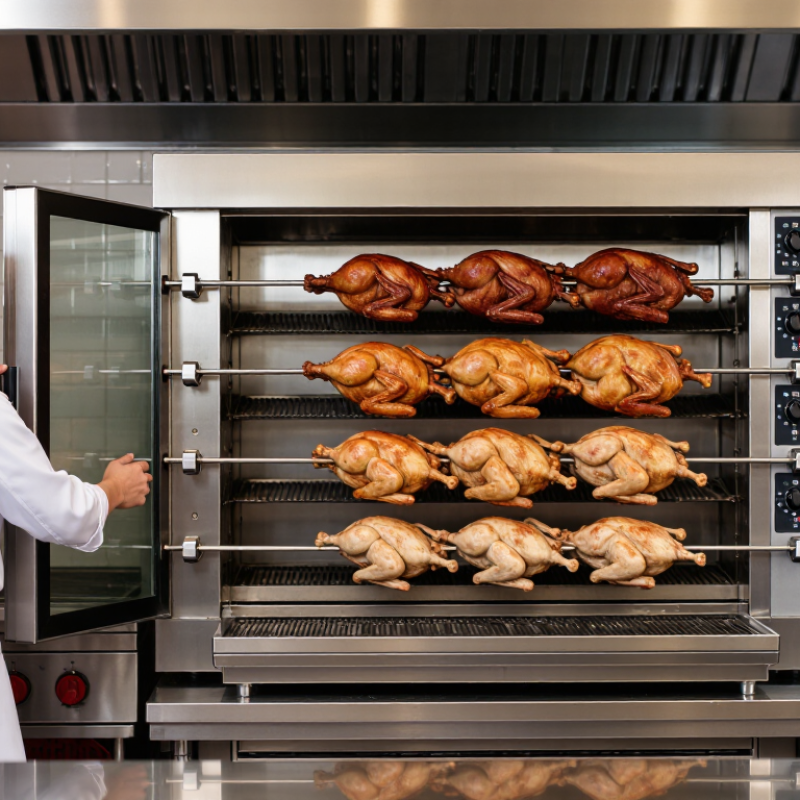
Capacity is not a picture. A seven-rack oven may not roast seven chickens. Rack spacing, spit diameter, and bird weight change the real output. Read the rated load in kilograms or pounds, then compare it with your usual batch size. Commercial models commonly serve six, twelve, or twenty birds, but those numbers require specific bird weights and loading patterns.
Ask for a test sheet showing capacity, cooking time, and power draw. The U.S. Department of Agriculture’s Food Safety and Inspection Service recommends cooking poultry to 165°F (74°C), measured with a food thermometer. A crowded chamber may reach that temperature unevenly. That matters more than an impressive rack count. The FDA Food Code 2022 also emphasizes temperature control for safe food handling, so verify recovery time after opening the door.
Check whether the rated load means raw whole birds, dressed birds, or fully loaded spits. I have seen capacity claims that looked generous but left little space for airflow. That is a useful warning. For a small counter-service operation, a six-bird unit may reduce waste and shorten cleaning time. A twelve-bird model suits steadier demand. Twenty-bird equipment needs stronger electrical planning, ventilation, floor space, and staff discipline. More capacity is not automatically better. Recheck your busiest hour, not your best sales day.
7 Tips for Buying an Electric Chicken Rotisserie Oven — Define Capacity by Rated Load, Rack Count, and 6–20 Bird Commercial Models
Capacity should be checked using three specifications: rated food load, rack count, and the number of whole birds supported. The scenarios below use a planning assumption of approximately 2 kg per dressed bird; actual capacity varies with bird size, spacing, rack design, and the manufacturer’s rated load.
Verify Poultry Safety at USDA’s 165°F (74°C) Internal-Temperature Standard
7 Tips for Buying an Electric Chicken Rotisserie Oven
USDA FSIS consumer guidance sets 165°F (74°C) as poultry’s safe minimum internal temperature. FDA Food Code 2022 also specifies 165°F for poultry. Tip 1: Choose an oven with a clear, removable temperature probe. Tip 2: Select a model with steady heat around the rotating spit. Hot spots can leave thick breast meat undercooked.
Tip 3: Check whether the probe reaches the thickest meat without touching bone. Tip 4: Prefer an oven with an easy-to-read display. Small numbers are difficult to read through steam. Tip 5: Look for a stable timer and automatic shutoff, but never trust the preset alone. A glossy control panel proves little.
Insert the probe into the thickest breast and inner thigh after cooking. The reading should reach 165°F, with no pink juices or cold center. Tip 6: Buy a model with removable racks and a washable drip tray. USDA research emphasizes preventing cross-contamination through careful handling and cleaning. Tip 7: Verify the electrical rating, door seal, and ventilation space before purchase. An imperfect habit is checking only the skin temperature; I have found the center matters more. Wait briefly, then test several points before serving.
Check Electrical Protection Under UL 1026 and 120/208–240 V Requirements
Before buying an electric chicken rotisserie oven, verify its electrical protection under UL 1026. This standard covers safety requirements for electric cooking and food-serving appliances, but certification may depend on the exact product category. Ask for the current test certificate, not only a printed compliance claim. Check over-temperature protection, grounding, insulation, cord construction, and resistance to grease near heating components. Small omissions matter.
Match the nameplate to your kitchen supply. A 120/208–240 V requirement is not automatically compatible with every outlet. Confirm voltage, phase, frequency, rated amperage, breaker size, and conductor capacity with a licensed electrician. A 120/208 V three-phase connection differs from a 120/240 V split-phase connection. The plug may fit, yet the installation could still be wrong. It happens.
NFPA reported 158,400 home cooking fires annually from 2017 to 2021, causing about 470 deaths, 4,150 injuries, and 4.7 billion dollars in property damage. Commercial kitchens face different conditions, including longer duty cycles and heavier grease exposure. The U.S. Fire Administration also identifies cooking as a leading source of structure fires. Ask whether the oven includes independent high-limit controls and accessible thermal cutoffs. Inspect the terminal block after delivery. Look for loose screws, crushed insulation, or moisture marks. I would not trust a perfect checklist alone. Installation quality still needs a second look.
Assess Cleanability Against NSF/ANSI 4 Commercial Food-Equipment Criteria
7 Tips for Buying an Electric Chicken Rotisserie Oven
Assess Cleanability Against NSF/ANSI 4 Commercial Food-Equipment Criteria
A clean oven protects more than appearance. CDC estimates that foodborne illness causes 48 million U.S. illnesses annually, including 128,000 hospitalizations (CDC, 2011). Examine the cavity, racks, spit rods, drip tray, and door seals before buying.
Tip one: look for smooth, nonabsorbent food-contact surfaces. Tip two: reject deep seams, exposed threads, and rough welds. These areas trap grease and poultry juices.
Tip three: check whether racks and trays lift out without tools. Tip four: inspect corners with a flashlight. A shiny interior can still hide residue. Tip five: confirm that removable parts tolerate the cleaning chemicals and temperatures specified by the manufacturer.
FDA Food Code 2022, Sections 4-101.11 and 4-602.11, emphasizes durable, corrosion-resistant, and easily cleanable equipment. NSF/ANSI 4 also addresses commercial cooking-equipment construction and cleanability. Certification helps, but verify the exact model and scope.
Tip six: test the door gasket by checking for gaps and hardened edges.
Tip seven: ask for documented cleaning instructions and service access.
USDA’s Economic Research Service estimated U.S. foodborne illness costs at $15.6 billion annually (USDA ERS, 2015). That figure makes maintenance worth serious attention.
I would not trust a certificate alone. Staff habits, cramped clearances, and rushed closing shifts can defeat excellent design. The awkward question is practical: can one employee clean every surface completely, every night?
Compare 1.5–6 kW Power Ratings, Heat Recovery, and Batch Energy Use
7 Tips for Buying an Electric Chicken Rotisserie Oven
Tip 1: Compare the power rating with your batch size. A 1.5 kW oven may suit small kitchens and occasional cooking. A 6 kW model recovers heat faster after opening, but it can demand heavier electrical service. More power is not automatically better. Check the circuit, plug, and installation requirements with a qualified technician.
Tip 2: Study heat recovery, not only maximum temperature. After loading chilled chickens, the oven should restore stable heat quickly. Ask for recovery data under realistic conditions, not empty-cabinet tests. Tip 3: Estimate batch energy use. A simple calculation is power in kilowatts multiplied by operating hours. For example, a 4 kW oven running for two hours uses about 8 kWh, before cycling adjustments. Actual consumption varies with insulation, door openings, and ambient temperature.
Tip 4: Compare cooking capacity honestly. A crowded 6 kW chamber may cook less evenly than a smaller, well-spaced unit. Tip 5: Inspect insulation, door seals, and heating controls. Small leaks become expensive during long shifts. Tip 6: Look for clear temperature readings and accessible cleaning areas. Grease buildup can affect airflow and recovery. Tip 7: Request service details and safety documentation. I would not trust vague efficiency claims. My first estimate might ignore preheating, which can noticeably increase daily energy use. Track one week of real batches before judging the oven.