Leave Your Message

China Top 10 Drawer Beverage Fridge Suppliers

Choosing a Drawer Beverage Fridge supplier involves more than comparing photos and prices. Buyers need to check usable capacity, drawer dimensions, temperature settings, and how smoothly loaded drawers open. These details matter in compact kitchens, hotel rooms, offices, and other spaces where a swinging door may be inconvenient. Small details count.

This guide to China’s top 10 Drawer Beverage Fridge suppliers offers a starting point for comparing manufacturers and their product ranges. It highlights practical questions about production experience, customization, quality checks, communication, warranty terms, and after-sales support. Buyers should request current specifications and confirm details such as operating noise, energy use, installation clearance, and delivery arrangements directly with each supplier. A polished product page is not proof of consistent manufacturing. Ask for clear documentation and, where practical, product samples or inspection evidence before making a decision.

The right supplier depends on the project. A hospitality buyer may value durable drawer slides and straightforward servicing, while a distributor may focus on packaging options and stable production capacity. No single ranking can reflect every need, and supplier information can change. Use this list as a comparison tool, not a guarantee. A careful review can narrow the field, but some unanswered questions may remain until samples, specifications, and commercial terms are checked.
China Top 10 Drawer Beverage Fridge Suppliers

Understanding Drawer Beverage Fridges and Their Main Applications

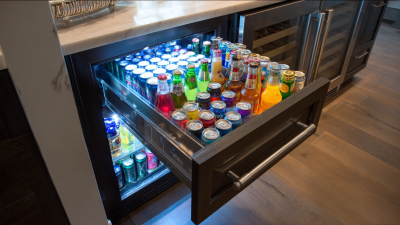
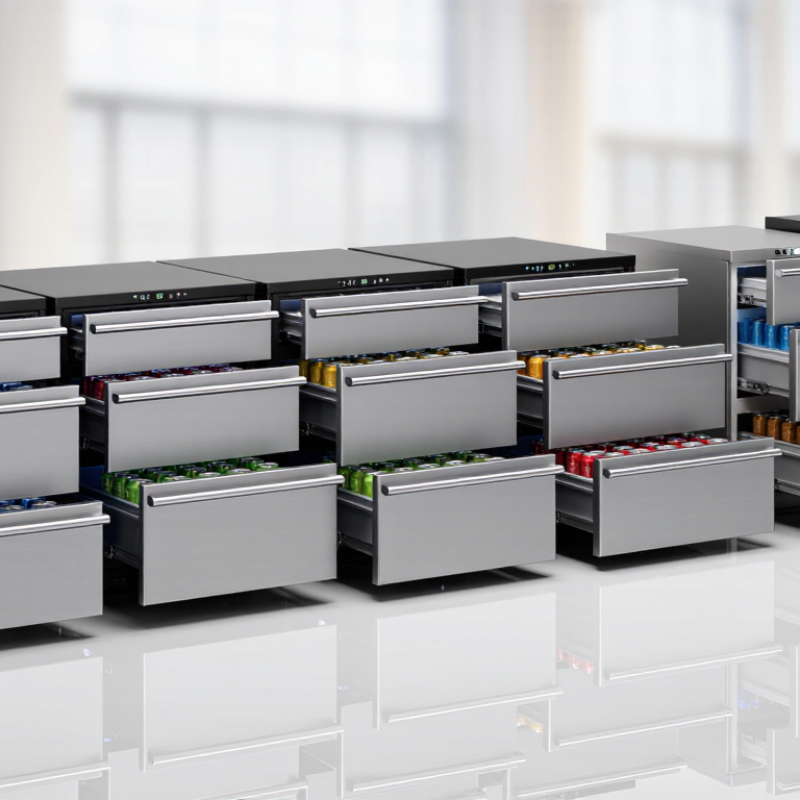
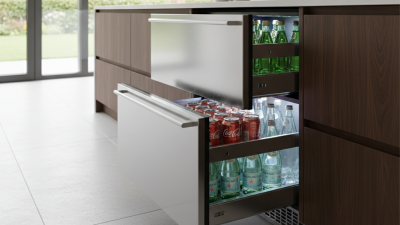
A drawer beverage fridge is a compact cooling appliance with sliding compartments that bring drinks forward instead of requiring users to reach through a front-opening cabinet. Depending on the design, drawers may include adjustable dividers for cans, bottles, or small cartons. The format can fit beneath a counter in a home bar, office kitchenette, or hospitality space where floor area is limited. It also makes stored drinks easy to see. Handy, but not magic.

Placement affects performance. Leave the ventilation clearance specified by the manufacturer, and avoid blocking the cooling system with cabinetry or stored items. Check the temperature range before loading drinks; different beverages may be best served at different temperatures.

In a busy kitchen, separate drawers can help keep everyday cans apart from bottles intended for guests. For a guest suite, a drawer unit near a seating area may reduce trips to the main kitchen. One trade-off is capacity: drawer interiors can be shallower than expected, especially with tall bottles. Measure the containers and the available opening first. Drawer organization sounds simple, but it still needs a little planning.
Overview of China’s Drawer Beverage Fridge Manufacturing Industry

China’s drawer beverage fridge manufacturing sits within a much larger refrigeration industry. The National Bureau of Statistics reported 96.09 million household refrigerators produced in China in 2023, up 14.5% year on year. This figure shows manufacturing scale, not drawer-fridge output; public data rarely separates this niche. The Ministry of Industry and Information Technology’s 2023 home-appliance industry bulletin reported sector revenue of about 1.84 trillion yuan. That broader figure signals a substantial supply base, but it cannot confirm any supplier’s capability in compact drawer models.

Production quality depends on details buyers can inspect. Ask for temperature-uniformity test results, drawer-cycle testing, insulation specifications, and noise measurements. Check whether loaded drawers slide smoothly and close firmly, even when the unit is installed beneath a counter. Small gaps matter. Export catalogs may list similar capacities, while compressor layouts, usable storage volume, and service support differ. I would treat unverified performance claims cautiously; a sample test under the buyer’s actual ambient conditions is more useful than a polished specification sheet. Makers also need to balance quiet operation, cooling recovery after frequent opening, and energy use. That trade-off is easy to underestimate.

Key Features and Standards Used to Evaluate Suppliers

When comparing China’s top drawer beverage fridge suppliers, evaluate the product and the evidence behind its specifications. Ask for temperature test records from a fully loaded cabinet, not just an empty unit. A useful test checks whether drinks stay within the stated range after repeated drawer openings. Ask for the room temperature and test duration, too.

Check drawer construction closely. Open and close each drawer under load, and inspect the rails, stops, gasket contact, and handle attachment. Small details matter. Request measurements for usable capacity, external dimensions, and clearance needed for ventilation. Compare noise and energy-use data under stated conditions. A neat brochure is not a test report.

Review quality controls and documentation before ordering samples. Ask how incoming parts, finished units, and temperature performance are checked, and whether records can be linked to production batches. Confirm that electrical safety and material documentation match the destination market’s requirements. Requirements vary. A supplier’s certificate may cover a different model or market, so verify its scope. Also discuss warranty terms, spare parts, and response times in writing. I would not treat a fast reply as proof of reliable service; sample testing can reveal issues that a factory visit or sales call misses.

Profiles of China’s Top 10 Drawer Beverage Fridge Suppliers

Profiles of China’s Top 10 Drawer Beverage Fridge Suppliers should compare practical capabilities, not just factory size. A useful shortlist covers integrated manufacturers, export-focused OEM/ODM factories, and specialists in compact drawer refrigeration. For each supplier, examine cabinet materials, compressor options, temperature stability, noise levels, and the smoothness of fully loaded drawers. Ask for test records and sample units; a polished catalogue alone proves little.

Energy performance deserves close attention. The International Energy Agency’s 2018 report, The Future of Cooling, projected that global energy demand for space cooling could more than triple by 2050. That forecast is not specific to beverage fridges, but it highlights why efficient components and good insulation matter. Compare stated energy use under the same test conditions, and check whether the supplier explains its measurement method.

Small details matter. A drawer that opens easily when empty may feel quite different with bottles inside.

The strongest supplier profiles also document production quality, customization limits, lead times, and after-sales support. Look for clear inspection steps, consistent temperature readings, and evidence that drawers withstand repeated opening. Some factories may offer broad customization, while others may deliver steadier production with fewer options. Neither is automatically better. One weakness in this comparison is that public factory data can be uneven, so buyers should verify claims through samples and direct technical questions.

Comparing Suppliers by Product Range, Customization, and Export Services

China Top 10 Drawer Beverage Fridge Suppliers

When comparing Chinese drawer beverage fridge suppliers, look beyond headline capacity. A useful comparison starts with product range: single- and multi-drawer models, temperature zones, installation clearances, and rated energy use. Check whether published capacity reflects usable interior space. Small details matter.

Customization should be specific, not just promised. Ask for dimensional drawings, drawer-load limits, finish samples, control options, and test results for a sample unit. The UNEP-led Global Cooling Watch 2023 projects that cooling demand could more than triple by 2050, while cooling-related energy use could double under current trends. This is a broad cooling-sector projection, not a forecast for beverage fridges alone; still, it makes efficiency data worth comparing carefully. A polished brochure is not enough.

Export service can distinguish otherwise similar suppliers. Compare response times, export packaging, loading plans, spare-parts availability, and the clarity of warranty terms. Request destination-specific documentation and written production and shipping schedules. A factory audit or pre-shipment inspection can help verify drawer alignment, temperature recovery, and packing quality. Yet no checklist removes every risk. Some details only become clear after a sample is tested under real operating conditions.